
précis
Scholarship Meets the Real World
As a year of geopolitical flux tested US foreign policy, Caitlin Talmadge and Dafna Rand found new purpose in their research, their networks, and their students.
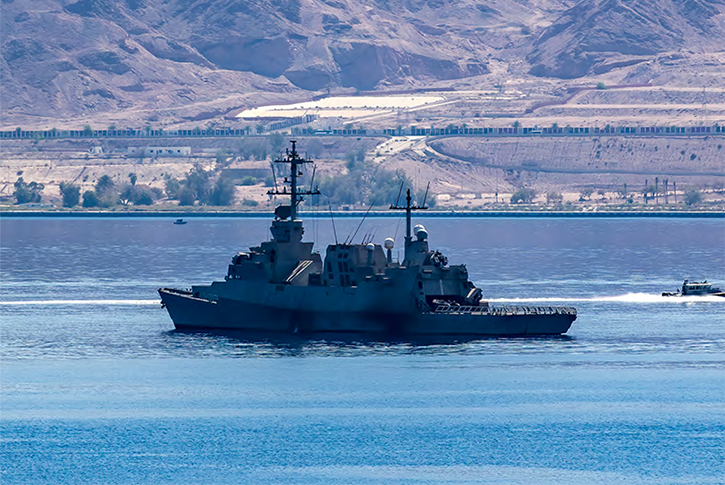
ON MARCH 30, 2026, in a crowded lecture hall at MIT, foreign policy experts convened to discuss the geopolitics of the Strait of Hormuz, a strategic waterway over which Iran had recently asserted control. Speakers pulled no punches in their assessments of this latest crisis in the US war against Iran, including two members of CIS.
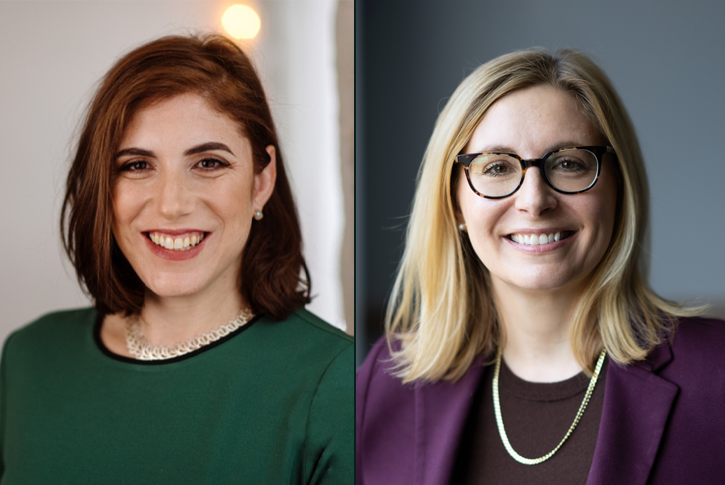
Dafna Rand, 2025-2026 Robert E Wilhelm Fellow, former assistant secretary of state for democracy, human rights, and labor, US State Department
Caitlin Talmadge, Faculty member, Security Studies Program and Faculty affiliate, Center for Nuclear Security Policy
“I think the US entered this war in the belief that it could very rapidly apply overwhelming military force and collapse the Iranian regime,” said Caitlin Talmadge, the Raphael Dorman and Helen Starbuck Associate Professor of Political Science at MIT. “Make no mistake about it, this regime is terrible and brutal … but the idea that air power alone was going to produce sweeping political change was misguided at best.”
This public event, sponsored by the MIT-Middle East North Africa (MENA) Program—one of many region-focused programs at CIS—provided insights from scholars in security studies, such as Talmadge, and from those steeped in the politics and players of the region, like Dafna Rand. A former assistant secretary of state, Rand joined CIS as the 2025–2026 Robert E Wilhelm Fellow—an honor granted to accomplished leaders in international policy pursuing innovative research.
“It is very important to understand that [Israeli Prime Minister] Bibi Netanyahu has believed for 20 years, and now convinced the top Israeli security apparatus and the public, that a nuclear Iran would mean the end of Israel as a state,” said Rand. “If this is your belief system, you are convinced that only a military conflict can deal with a nuclear problem.”
The forum’s frank exchange of views galvanized online and in-person audiences, as well as panelists. For both Rand and Talmadge, the Strait of Hormuz panel epitomized CIS at its best: a place where real‑world experience and rigorous scholarship meet in public.
“I thought this panel really popped with different perspectives,” says Talmadge, who notes that she has incorporated Rand’s perceptions about Israeli decision-making into her class about the war. “It’s an example of having that deep well of expertise in our community to draw on, to engage the public, to inform and discuss and debate, not just in our little ivory tower, but in a broader context,” she says.
“This is where the policy perspective on international affairs can meet up with the academic study of political science,” in a space that is “trying really hard to promote the best parts of democracy—the market place of ideas.” says Rand.
For Rand and Talmadge, a year of dramatic change in US foreign policy reinforced their research agendas—and highlighted the constructive role CIS plays in supporting scholars’ work.
For Talmadge and Rand, a year that brought dramatic change to US foreign policy served to validate, if not energize, their research agendas, and to underscore the constructive role CIS plays in scholars’ work.
“The turbulence reinforced the value of long-term expertise already built within CIS and the MIT Security Studies Program,” says Talmadge.
Talmadge highlights an “informal but influential” faculty discussion group that gathered regularly to talk about current events.
“It was nice to lift our heads up from our desk or take a breather from the demands of teaching and advising, and come together with an eye toward thinking about future research.”
During these sessions, Talmadge and her SSP peers discussed a range of topics, she says: “What does this war tell us about the limits of US military power or about the potential future trajectory of a US‑NATO conflictor a US‑China conflict? What does this war mean for the future of alliances?”
Her CIS network includes regional and global scholars and practitioners “from whom you gain more context and understanding,” says Talmadge. “It’s a testament to what CIS does that there are so many people who have expertise on different dimensions of the conflict, people from whom we try to draw an understanding of what’s going on, so we can inform the public, and perhaps influence policy decision making.”
A widely recognized expert, Talmadge has also been tapped by major media outlets to weigh in on the Hormuz crisis, including an article she wrote for Foreign Affairs, and being quoted in the New York Times, Financial Times, the Economist—to name a few.
After watching the Trump administration dramatically reorient the State Department, and witnessing the closure of USAID by the Department of Government Efficiency (DOGE), Rand says she embraced “this year as an opportunity to recharge my intellectual batteries.”
As a Wilhelm Fellow, Rand planned broadly to focus her year addressing how technologists view the federal government and national security debates, and to the question of how to reform big institutions such as federal agencies without destroying their core functions. “CIS has this special sauce of both social scientists and hard scientists, and I wanted to join this new community.”
Among her fellowship projects, Rand, who had helped implement parts of the CHIPS and Science Act in the Biden Administration, engaged MIT scientists in a panel to debate export controls and regulation. Rand believes that in order to prevent US hardware and software from enabling authoritarian surveillance and abuse, there should be a mechanism for balancing national security, human rights, commercialism, and scientific openness.
She also helped co-create a “MENA Futures” concept under the MIT-MENA Program. This cross‑disciplinary, problems‑focused MIT initiative intends to explore and shape long‑term, technology‑driven futures for the Middle East and North Africa, especially around food, water, energy, and climate.
“The project depends on the slightly utopian idealism of the technologists at MIT,” and seeks to imagine concrete collaborations with governments and publics in the region. “The MIT-MENA leadership—Richard Nielsen and David Dolev—and I created something real. My hope is that MENA Futures becomes a new landmark part of the CIS program, Rand says.”
While at MIT, Rand conducted “lessons-learned” work about how the US accrues and uses leverage with security partners in places like Ukraine, the Saudis in Yemen, and Israel in Gaza “to end wars, and shape their conduct.” Her final report will be published by the Brookings Institution with a link on the CIS website.
For Rand, the CIS experience offered a bridge from raw, lived crisis-based decision-making to structured research, a launchpad for new institutional ideas, and more personally, a reset from her previous life in public service to the next phase. “There’s an inherent optimism about MIT and CIS that is really beneficial,” says Rand.
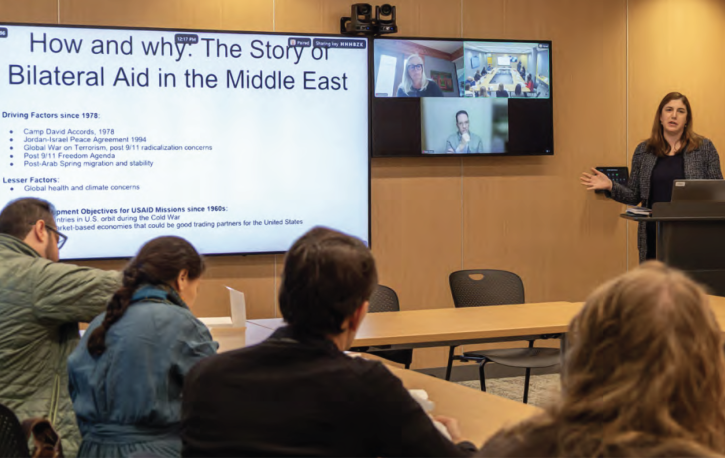
Dafna Rand speaking at a lunchtime seminar sponsored by the MIT-MENA Program.
For Rand and Talmadge, gifted, idealistic students are the beating heart of both the CIS community and MIT at large.
“I spent time with students at both the PhD level and the undergraduate level, and it’s been particularly useful to begin to understand how the brilliant minds at MIT, the people who are going to be leaders of our industry and our technological advances—think,” says Rand. “Our society and country need the talent here.”
Her students’ achievements are the true measure of her impact as a professor, says Talmadge. “I truly believe that they are amazing and do really important things in the world,” she says.
“Whether they go on to become political scientists or analysts or work in the government directly on these issues of war and peace, or on technological applications, the teaching and the research that we do at CIS can be meaningful and can contribute and have an impact.”
Rand takes this a step further: At a moment when Washington’s standing in the world has been shaken, she believes that “the US government does not need to be the only or even the main modality for US diplomacy. There’s absolutely no reason why an MIT should not be representing what’s best about America abroad.”


