
précis
Rethinking Humanitarian Aid in a World of Conflict and Crisis
David Miliband, an MIT alumnus and former CIS fellow, met with students and faculty, and delivered a Starr Forum examining how humanitarian aid must adapt to a changing world.
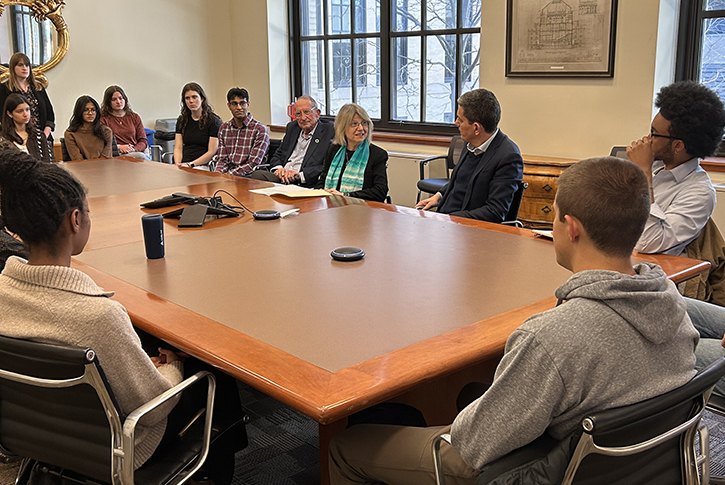
THE CENTER WELCOMED MIT ALUMNUS and former CIS Wilhelm Fellow David Miliband back to campus in April as the featured speaker for a Starr Forum on “New World Disorder: What’s the Humanitarian Perspective.”
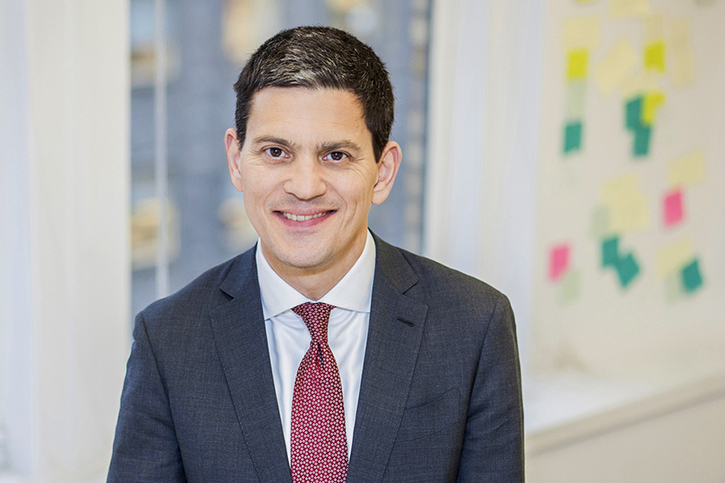
David Miliband SM ‘89, 2011 Robert E Wilhelm Fellow, and President and CEO, International Rescue Committee
Drawing on his experience as president and CEO of the International Rescue Committee (IRC), Miliband’s talk brought together members of the MIT community to examine the changing nature of global humanitarian crises and the reforms needed to address them.
The forum was opened by Evan Lieberman, CIS director, who welcomed Miliband back to MIT, where he earned a master’s degree in political science in 1989 and later served as a CIS Robert E Wilhelm Fellow in 2011.
The discussion was moderated by MIT Professor Emeritus John Deutch, former head of the chemistry department, dean of science, and provost. He also served as the US deputy secretary of defense and director of the CIA.
“In my government service, I observed closely many cases where people were suffering in the world and nobody was paying attention. It’s important at MIT that we pay attention to the suffering around the world and what we can do to help alleviate it.”
Miliband’s return to MIT was made at the invitation of Deutch and coordinated in partnership with the Office of the Vice Provost of International Affairs.
In addition to the Starr Forum, Miliband’s visit included a meeting with MIT faculty, students, and leadership, including President Sally Kornbluth.
“At a moment when international development and humanitarian assistance are growing ever more complex, it is especially important that we come together to share ideas that can help advance practical solutions,” said Kornbluth. “David Miliband’s thoughtful, unwavering leadership has been invaluable in bringing insight, conviction, and a deep sense of purpose to this urgent work.”
Speaking at the Starr Forum, Miliband argued that our current humanitarian organizations must rethink how they respond to global crises because the geography of extreme poverty has changed dramatically over the past three decades.
Nearly a century after its founding by Albert Einstein and other humanitarians, the IRC has stayed true to its mission to provide urgent assistance and lasting solutions to communities upended by war and other crises. Yet over that same century, the world in which IRC staff and volunteers operate has profoundly changed, said Miliband.
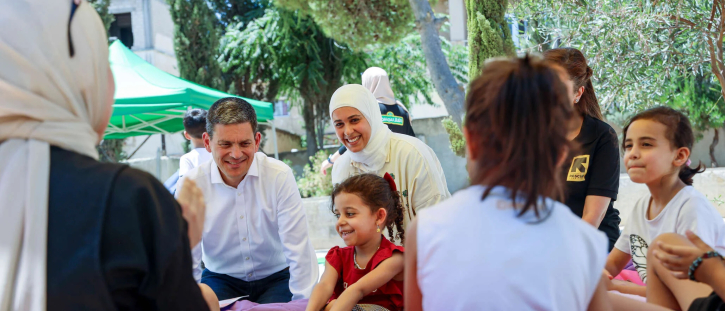
Miliband has led the work at the International Rescue Committee since 2013.
Recent decades have seen the biggest shifts, Miliband told the MIT community, most notably the “changing geography of poverty.”
Miliband noted that 10 percent of the world’s population lives in extreme poverty, existing on less than $3 per day.
“The biggest point I want you to take away this evening is that the distribution of that 10 percent, those 800 million people, is radically different than what it was 30 years ago. Thirty years ago, the vast bulk of the extreme poor lived in countries like China and India, which were relatively stable states,” said Miliband, who has led the IRC since 2013 after serving in several senior positions in the UK government. “Today, we’re in a radically different position. Sixty percent of the extreme poor in the world live in what are called fragile and conflict-affected states. So, it’s not the Chinas and Indias of this world. It’s the South Sudans of this world. It’s the Afghanistans of this world. It’s the Gazas of this world.”
Previously, he said, aid organizations such as the IRC could work with governments such as China and India to develop support systems for impoverished communities. Today, however, most of the world’s extremely poor people live in places where their governments are not in control.
“In fact,” Miliband said, “200 million people live in areas of the world that are controlled by non-state armed groups. So, the strategies for reaching those people have to change radically to make a difference.”
Efforts to alleviate this suffering are currently hampered, Miliband said, because “the global aid system is still structured as if we’re living in the 1990 version of the distribution of poverty. The aid system still reflects the old geography of poverty, not the new.”
For example, he said, the 20 countries on IRC’s emergency watch list—where 90 percent of people in need of humanitarian assistance live—receive only 26 percent of the global aid budget. Excluding Ukraine, which he called “the best-funded humanitarian crisis in the world,” the remaining 19 poorest and conflict-affected nations share just 14 percent of global humanitarian aid funding. Compounding this imbalance, Miliband noted that 16 of the 20 rank in the top quartile of the Notre Dame Index of Climate Vulnerability, underscoring what he described as “a very stark correlation” between the climate crisis and extreme poverty.
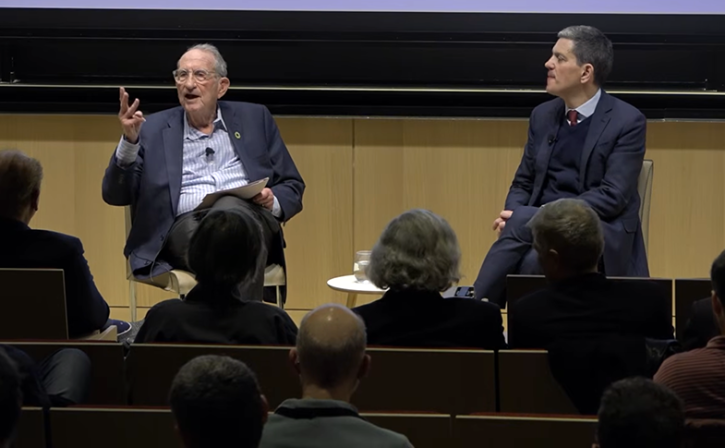
John Deutch served as the moderator for Miliband’s Starr Forum talk on global humanitarian challenges.
Aside from climate, Miliband pointed to four economic, political and social forces driving the shift in the geography of extreme poverty: a hyperconnected world that makes risks, such as pandemics, more global than ever; the fragmentation of global politics, resulting in a world with several centers of power that are “in different alignments on different issues”; the “growth of impunity” and disregard for international rules; and the growing industry of “profiteering from war economies.”
Meanwhile, funding available to address these challenges has shrunk. The IRC had to absorb a $400 million budget cut from the US government, resulting in the loss of services for two million IRC clients worldwide. The governments of Germany and the United Kingdom have also reduced their aid budgets, Miliband said.
Against this backdrop, the IRC has developed what Miliband described as a “recipe” for addressing the disorder shaping today’s humanitarian landscape. First, he said, resources must be focused on the areas of greatest need—namely the 20 countries that currently receive only 26 percent of global aid funding. Second, humanitarian organizations should invest in programs that have demonstrated measurable results.
“The biggest thing we need to do is scale the proven programs,” Miliband told the audience.
Third, he highlighted the IRC’s “innovation agenda,” which is focused on developing new products and services as well as new ways of delivering humanitarian assistance.
He added that some solutions lie beyond the reach of humanitarian organizations alone.
“Obviously, if you want to get to the roots of these problems, humanitarian aid can stanch the dying, but you need politics to stop the killing,” he said.
During a separate meeting with MIT students, Kornbluth asked Miliband to identify the greatest challenges facing humanitarian leaders today. He cited two: delivering meaningful impact in places where access is constrained, civilian protection is eroding, and community needs are increasingly complex; and defending “the very idea of principled humanitarian action.”
“Today’s biggest leadership challenge for organizations like the IRC is navigating the gap between growing crises around the world and the decline in political will to address them,” he said. “The task is not only to deliver aid effectively in increasingly complex conflicts but also to defend the principles and reform the systems that make effective humanitarian action possible in the first place.”


