
Commentary
When Singapore starts to worry about Washington
Joanne Lin, Fulbright Fellow at CIS, examines Singapore’s increasing discomfort with US leadership under President Trump, as reflected in the 2026 State of Southeast Asia Survey.
Joanne Lin, Fulbright Fellow at CIS, examines Singapore’s increasing discomfort with US leadership under President Trump, as reflected in the 2026 State of Southeast Asia Survey.
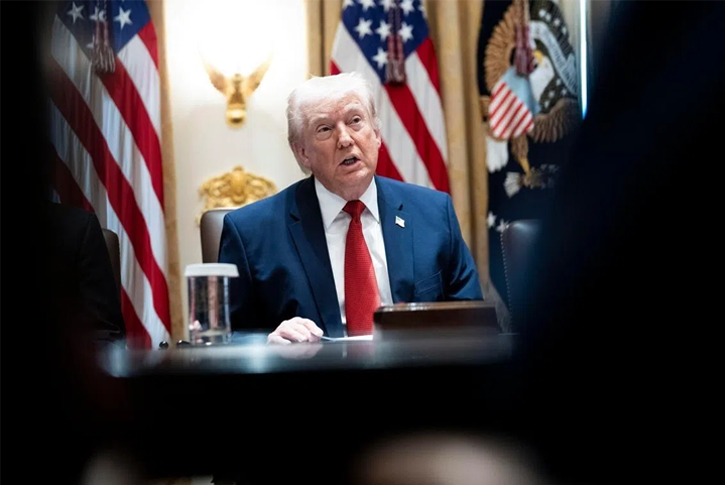
This year’s State of South-east Asia Survey contains a striking result: Singapore, long regarded as one of Washington’s closest andmost pragmatic partners in the region, is now among the most uneasy about US leadership under President Donald Trump. Itdoes not suggest that Singapore is turning against the US. Rather,it reflects growing discomfort with an America that remainsstrategically important, but is increasingly seen as less predictableon trade, less reassuring on international rules and less stable asan anchor of regional order.
The survey published by the ASEAN Studies Centre at the ISEAS –Yusof Ishak Institute drew on the perspectives of 246 respondents from Singapore. They represented a broad cross-section of informed stakeholders from academia and research, government, the private sector, civil society and media, and regional or international organizations. The unease of these stakeholders is borne out across several key questions in the survey. Among allASEAN countries, Singapore respondents registered the highest level of concern about US leadership under President Trump, with 76.8 per cent identifying it as a top geopolitical concern.
Singapore respondents have also become markedly more apprehensive about US influence. In the economic domain, 61.7 per cent expressed concern – a sharp change from 2025, where 41per cent were worried.
On the political and strategic front, 65.4 per cent expressed apprehension over the US posture, again a significant shift from the previous year at 37.8 per cent. This represented the largest deterioration in sentiment among all ASEAN countries, pointing to a clear decline in Singapore’s comfort level with the American leadership.
Valuing a rules-based order
Singapore’s sharp reaction reflects what it values most in the external environment – open trade, secure sea lanes, predictable rules and a stable balance of power. As a small, highly trade-dependent state, Singapore is especially exposed to disruptions in shipping, markets and the wider rules-based order.
Prime Minister Lawrence Wong warned in 2025 that the new US tariff measures marked a “seismic change” in the global order and signalled the end of the era of rules-based globalization and free trade.
More recently, Foreign Minister Vivian Balakrishnan made clear inParliament that Singapore would not negotiate for safe passage through the Strait of Hormuz because transit passage under international law is a right, not a privilege. That instinct is deeply embedded in Singapore’s foreign policy. For a small state, the issue is not the extent of power in itself, but whether it is exercised through predictable rules or through pressure and coercion.
That helps explain why the survey’s findings on free trade and the rules-based order matter so much. Regionally, confidence in the US to champion global free trade fell markedly, placing it behind ASEAN, China and the EU. In Singapore, confidence in the US on this question is especially weak and far below the regional average.
Similarly, on the issue of who could provide leadership in maintaining a rules-based order and upholding international law, ASEAN was rated ahead of the US at the regional level. Singapore respondents, in particular, rated the US well below the regional average. The deeper significance of these findings is thatSingapore is not simply worried about tariffs as an economic cost. It is increasingly uncertain whether Washington still represents the kind of external order on which small states like Singapore depend.
That unease also carries into expectations for the bilateral relationship. Among Singapore respondents, 43.5 per cent expect relations with the US under Trump 2.0 to worsen, while another 43.5 per cent expect them to remain unchanged – a markedly more downbeat outlook than from the rest of the region.
When asked what Washington could do to improve relations, the top response from Singapore respondents is that the US should respect international law and its institutions and not undermine the global system. The next most cited response was that it should pursue free trade and strategic partnerships instead of punitive tariffs. The message is clear. Singapore is looking for reassurancethat the US can still act with consistency and reassurance.
Growing distrust
Trust has also eroded, in tandem. The survey shows that distrust in the US rose most sharply in Singapore, climbing from 47.2 percent in 2025 to 62.6 per cent in 2026, the highest level of distrust among all ASEAN countries.
Singapore is also among the more sceptical ASEAN countries on whether the US remains a reliable strategic partner and provider of regional security. Yet this does not mean Singapore sees no value in the American role. Rather, the findings could point to amore differentiated view that Washington is still regarded as strategically relevant, but far less dependable as a broader anchor of order.
Among Singapore respondents who distrust the US, the leading concern is that they do not consider the US a responsible or reliable power. A quarter of respondents believe that American economic and military power could be used in ways that threaten smaller countries’ interests and sovereignty – an anxiety reinforced by Singapore’s grave concern over US intervention in Venezuela, contrary to international law.
Hedging one’s bets
The survey’s forced-choice question should also be read in that light. If ASEAN were compelled to align with one of the two major powers, 66.3 per cent of Singapore respondents chose China (up from 47.1 per cent in 2025) and 33.7 per cent chose the US. This makes Singapore the third most China-leaning among ASEAN countries after Indonesia and Malaysia. This should, however, not be read as a strategic tilt to Beijing, but as a sign that when confidence in Washington weakens, the impulse to hedge and diversify grows stronger.
That same instinct is reflected elsewhere in the survey whereSingapore respondents favorr increasing intra-regional trade and investment to strengthen ASEAN’s resilience, while also deepening cooperation with like-minded partners beyond ASEAN in response to protectionism and nationalism.
Beyond the survey, businesses are urged to diversify markets and supply chains, while the Government has moved to widen trade links, strengthen supply-chain resilience and deepen issue-based partnerships with like-minded economies such as the Future ofInvestment and Trade Partnership to support a more open and predictable trading environment.
Fundamentally, what appears to set Singapore apart from its ASEAN peers is not just its size, but also the degree to which its prosperity depends on open trade, policy predictability and a rules-based environment.


