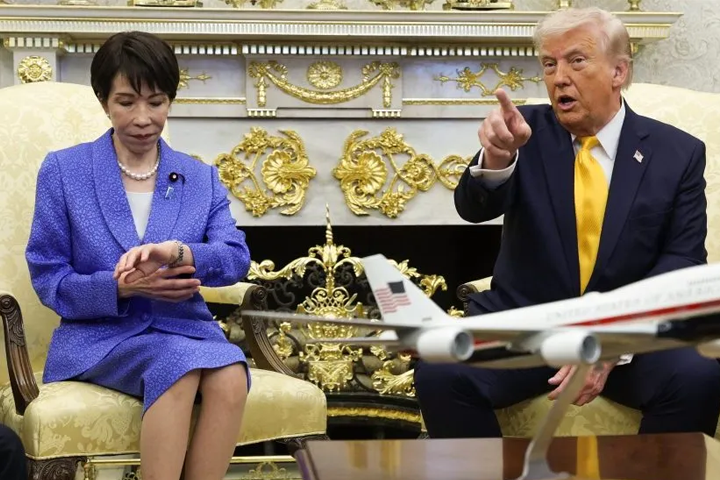
The 19 March summit between US President Donald Trump and Japan’s Prime Minister (PM) Sanae Takaichi will be remembered less for a breakthrough than for what it avoided. Held in the shadow of the US’ and Israel’s war against Iran and renewed US pressure on its allies to do more, the meeting carried a real risk of exposing a serious rift in the bilateral alliance.
PM Takaichi upheld her country’s red line, that Tokyo will not send its military to assist US-led military efforts in the Persian Gulf, redirecting the conversation towards areas where Tokyo could demonstrate value without crossing its constitutional and political limits.
The bigger concern is whether the two allies see eye-to-eye on the issue of Taiwan and how to manage the challenges posed by China. At one level, the two sides reiterated willingness to cooperate on deterrence against potential adversaries (read: China), the ‘free and open’ Indo-Pacific strategy, missile co-development and coordination over China and North Korea. Trump, however, has made little secret of his disappointment that allies dependent on Gulf energy flows have not done more to support the US’ efforts to secure shipping lanes.
For Japan, the US request puts it in a delicate situation: the need to secure the shipping lanes is a direct result of the US’ attack on Iran, but Tokyo’s hands are tied. Tokyo is constrained by constitutional interpretation and the legality of any decision to sanction the use of force by its military. Japan’s 2014 security legislation allows the use of force in support of an ally only when Japan’s survival is at stake and no other “appropriate means” are available. The threshold has not been crossed here, given that Japan’s survival is not at stake.
In this context, Takaichi’s task was to decline to join a US-led military effort in the Gulf and to convince Trump that this does not amount to disloyalty to their alliance. By that measure, she appears to have succeeded. Tokyo’s official account of the meeting struck a careful balance, expressing concern over Iran’s effective closure of the Strait of Hormuz and threats to freedom of navigation, while reiterating that Iran must not be allowed to acquire nuclear weapons (Japan had opposed Iran’s nuclear programme following the US-Israeli strikes on the country’s nuclear-related facilities in June 2025). At the same time, Japan shifted the discussion towards enhancing US-Japan coordination on energy security, increasing imports of US energy and stockpiling arrangements, the summit’s most important takeaway.
The alliance remains strong. In its 2025 National Security Strategy (NSS), the US deems the western hemisphere to be of paramount importance, followed by a focus on managing the China challenge in the Indo-Pacific. The US-Japan alliance would be central to Washington’s strategy. While the situation in Iran and the Middle East is serious, the US’ and Japan’s challenges lie in the Indo-Pacific. The challenge posed by China, the world’s second-largest economy and a formidable military power, is on a different level compared to Iran.