
News
Testing sustainability in Barcelona
A MISTI Global Classroom confronts climate change one farm and co-op visit at a time.
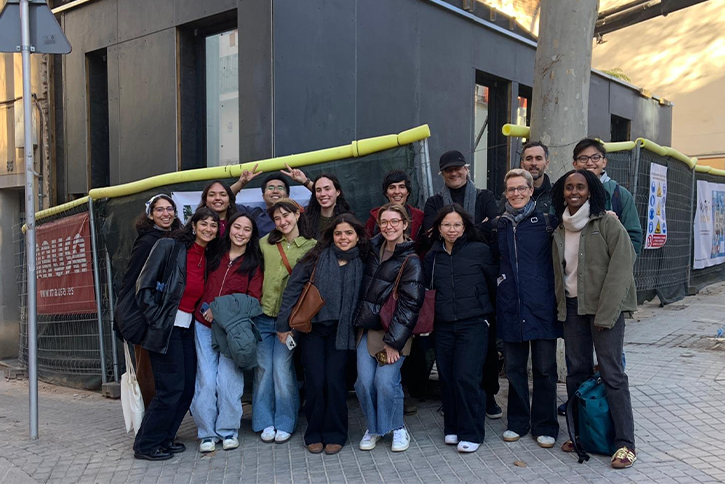
Kate Brown (front row, second from left), the Thomas M Siebel Distinguished Professor in the History of Science, with her MISTI Global Classroom in Barcelona, Spain.
This past January, twelve MIT students set out for Barcelona — not just to study climate resilience, but to experience it firsthand. As part of How to Grow Resilient Futures: Regenerative Agriculture and Economies in Catalunya, Spain, a course taught by Kate Brown, the Thomas M Siebel Distinguished Professor in the History of Science, they stepped beyond the classroom and into living systems of sustainability.
Offered during IAP as a Global Classroom through MIT International Science and Technology (MISTI), the course reimagined what learning could look like. Instead of working their way through a syllabus containing texts about sustainable farming and the power of cooperatives, Brown’s students got their hands dirty.
In fact, quite literally: they visited local farms and slaughterhouses, prepped, cooked, and served a cooperative dinner to migrants, and constructed a working greenhouse. In the process, they built a lasting community and forged their own visions about sustainability and how they are compelled to confront climate change as MIT students now, and eventually, as alumni.
“I wanted the students to think about alternatives to the notion of capitalist development, where the latest technology is seen as the solution to every social problem that emerges. I wanted them to see ways people are solving problems in a place like Barcelona, where communities and ecologies are centered as part of the solution," Brown said.
Through Brown’s partnerships at the Barcelona Urban Research Institute (IDRA) and Research and Degrowth (R&D) – and MISTI Spain’s infrastructure – the group of eight undergraduates and four graduate students had the opportunity to examine the historical roots of cooperative movements in the region while simultaneously experiencing today’s iteration of co-op work.
Brown intentionally designed the three-week syllabus to push students beyond the classroom walls and get them face-to-face with local MISTI Spain partners from across the farming and ecology sectors. For example, the class met with Pino Delàs, a pig farmer who left the industrial system to start his own localized, cyclical operation called Llavora, which supported community farming and generated significantly less waste.
Rooted in community
With more than a century of creating cooperatives – both workers and farms – Barcelona and its Catalonian roots provided an ideal environment for the students to consider Brown’s questions through fieldwork rooted in community.
Within their first week on the ground, they collaborated with volunteers at the Agora Squat. The small “pocket park" was initially slated to be developed into a luxury hotel, but a local group of 200 neighborhood residents came together to protest the plan, instead exercising their legal right to use the land, a caveat in Spanish law that allows neighbors to make a case for possessing land that isn’t being used productively. Now, the lush green square boasts a community kitchen and gardens. One night a week, volunteers provide dinner for upwards of 60 recent North African migrants, using ingredients sourced from local fruiterias and shops that would have otherwise gone to waste at the close of business.
On this particular Thursday, Brown’s students became non-profit managers and chefs, but they also became community members themselves. In just a few hours from start to finish, the students had to source donated produce from the local vendors, come up with a recipe using what they’d gathered, and then prepare a meal in the rudimentary kitchen. “They received a lot of turnips and had to create a recipe to use them,” Brown said. In the end, a flavorful stew simmered in a massive metal pan over propane burners, brought alive with fresh chilis picked from the garden.
“This was way outside some students’ comfort zones,” Brown said. Yet, that was exactly the point of the activity. By the end of the evening, the students discovered that sometimes the most profound educational moments take shape only after challenging the limits of learning.
“Many of us do not consider ourselves chefs, so it was empowering to discover that, together, we had the capacity to create a nourishing meal for 70 people, with produce that would have otherwise gone to waste. This meal that we created on the spot, in combination with many of the other workshops during the program, was a strong reminder of how much agency each of us has to effect change within isolating and constraining systems, especially in community with like-minded individuals,” said Sonia Torres Rodriguez, a first-year PhD student in Urban Studies and Planning, Course 11.
Torres Rodriguez focuses her doctoral research on affordable and climate-resilient housing. She was drawn to the IAP program's exploration of innovative approaches to more equitably distributing the means of producing housing and food, and was excited to be learning in person in Spain. “Cooking together, admiring healthy regenerative soil, foraging, learning traditional methods to braid grass, installing mini solar panels, and hosting poetry circles, would have been impossible to replicate on Zoom,” she said.
Calvin Macatantan ‘26, computer science and urban studies and planning, was initially drawn to the program because of his interest in resilient economies and how they support the communities they serve. Other than visiting family in the Philippines, he’d never left the United States before. He was especially moved by the group’s stay at La Bruguera, an eco-resort partnered with R&D that serves as a “living laboratory.” The cohort heard from local experts in regenerative agriculture, soil health, and low-tech agroforestry, alongside hands-on activities such as eco-art therapy sessions, weaving lessons, and the rebuilding of a greenhouse.
As part of a final project for the course, Macatantan and another student wrote and illustrated a children’s book that explains La Bruguera’s work by making the soil come to life as the main protagonist for young readers.
Brown’s course pushed Sofia Espindola de La Mora ‘29 to think more critically about everyday systems and their environmental impact. Originally from Puerto Rico, the freshman watched helplessly in recent years as climate change has increased the frequency and magnitude of natural disasters at home.
She came to MIT looking for answers and wanting to make a difference, and signed up for Brown’s course as part of that quest. “It was fascinating to see firsthand that the degrowth movement doesn’t mean slowing down is a bad thing, but instead that the constant striving for more is what has led us to many of the predicaments we now face as a society. It forced me to think about whether it would even be possible for me to sustain the life I have now using renewable energy,” Espindola de La Mora said. The course convinced her to focus her studies on climate system science and engineering.
A climate context
Broadening students’ perspectives was a priority for Brown, whose research lies at the intersection of history, science, technology, and bio-politics. She’s known on campus for courses like the History of Food Production and Environmental History. Her 2026 book, Tiny Gardens Everywhere: The Past, Present and Future of the Self-Provisioning City, examines urban systems including gardens.
When Brown was designing the Global Classroom—made possible through MISTI, with additional support from the MIT Energy Initiative—she centered a value she considers imperative in any course today: addressing climate and other human-driven environmental challenges.
“I’m focused on training students to approach these problems at the local level, so they see what happens when they're working through communities, rather than prescribing to them something to scale all over the world,” Brown said.
That localized, individualized approach helped expand on what the students initially believed was possible and compelled them to become part of the solution through their studies and in their professional lives.
Since their return to campus, Brown’s students have continued to lean on one another and build community one meal at a time. Many Tuesday nights, they come together to cook dinner, Barcelona squat style. Each individual brings their ingredients, and together they create a recipe that nourishes and sustains.
“I was losing a lot of faith in the world before this trip,” Macatantan admitted. “We’re constantly surrounded by consumption and the drive to do more. This experience helped me realize that I want to do something that impacts people. For me, that will look like research. I want to become an expert in a subject and become someone who can help communicate that knowledge to people who need it.”
“I was excited when Professor Brown approached me to help shape this new class, knowing it would resonate with students,” said Alicia Goldstein Raun, associate director of MISTI and managing director of the MIT-Spain Program at the Center for International Studies. “The students tackled global challenges like climate change and explored the degrowth movement while immersing themselves in Spanish communities and culture.”
“MISTI Global Classrooms like this show what happens when learning extends beyond the MIT campus,” said Raun.
For faculty interested in designing a MISTI Global Classroom, more information can be found here.


