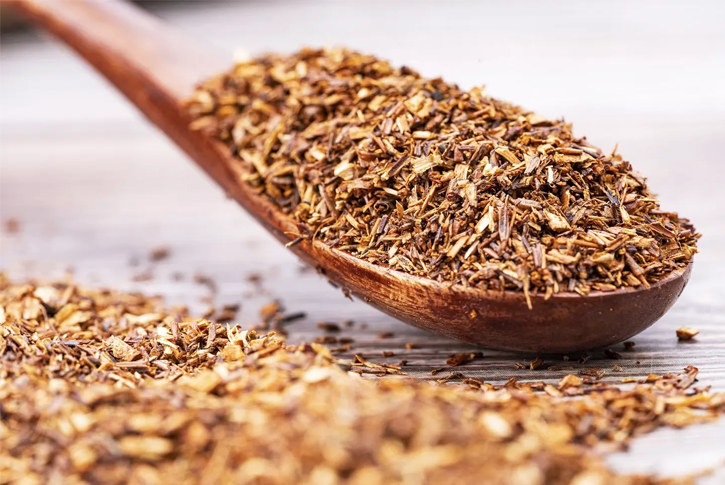
I first tried rooibos tea while traveling to South Africa back in 1991. My initial reaction was that it tasted nasty and medicinal. Not something one would drink for pleasure.
During the course of a year interning at a South African NGO/think tank starting in 1997, the ritual of tea time helped to refine my palate. Each day, colleagues gathered in a designated area with a hot kettle. Since the only coffee option was a freeze-dried instant out of a jar, I began reaching for rooibos with increasing frequency, and soon my skepticism turned to enthusiasm. I came to appreciate its woody flavor, that it was less bitter than regular black tea, and generally more flavorful than most herbal teas.
Now, barely a day goes by when I don’t have at least one cup, usually with some milk and a bit of agave. I start each morning with some form of coffee, but once my caffeine intake has been satisfied, I switch gears. Rooibos is caffeine-free, rich in antioxidants, and reputed to have various (not exactly rigorously demonstrated) health benefits. I choose to believe these claims.
Rooibos, pronounced ROY-boss, means “red bush” in Afrikaans. It’s actually an herb, not a tea leaf, so it’s more accurately “tea-like.” Rooibos only grows naturally in a relatively small part of western South Africa. Its marketers tout the Cederberg’s soil as akin to a French terroir for wine. In 2021, the EU designated that only the herb grown in a particular part of South Africa can be called “Rooibos,” just as Champagne maintains its designation within the wider universe of sparkling wines.
Over the past few decades, rooibos has gone from a hyper-local beverage consumed almost nowhere outside of South Africa, to a globally enjoyed commodity. And in turn, it’s now a pretty big business. According to the South African Rooibos Council, in 2025 the herb was exported to about 50 countries; and they sold enough to make about 10 billion cups. The council was understandably happy that China recently eliminated tariffs on Rooibos exports.
The opposite is true for the United States as our tariff went from 4.8% in 2021 to 30% under the Trump administration (and I couldn’t verify exactly where the rate stands today). While this is part of Trump’s global tariff regime, relations between our countries have deteriorated precipitously during his presidency.
I am hopeful for a future drop in the tax, not simply on behalf of fellow consumers, but as a signal that we are mending fences.