
News
Rethinking US technology-enhanced development in Egypt and Jordan
The MIT-MENA Program launches “MENA Futures” series featuring regional expertise across multiple sectors.
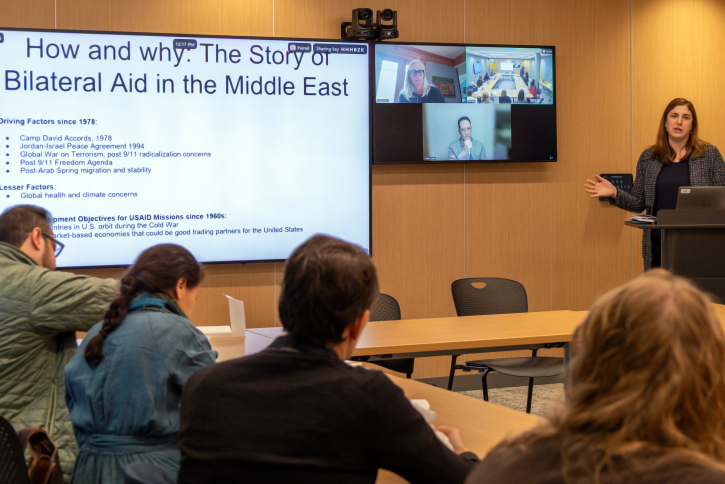
Dafna Rand, Robert E Wilhelm Fellow at CIS, speaking at the first event.
The inaugural “MENA Futures” talk on March 10 focused on the future of US technology-enhanced development approaches in Egypt and Jordan. It was facilitated by Dafna Rand, the Robert E Wilhelm Fellow at CIS and former US assistant secretary of state, and featured former USAID mission directors Leslie Reed (Jordan) and Sean Jones (Egypt), alongside MIT faculty and researchers.
The event examined how development priorities around employment, energy, and water have evolved, and what role academic institutions like MIT might play in shaping future engagement with the region.
Rand began by situating US development assistance within its broader historical and strategic context. Large bilateral aid programs in the Middle East were originally shaped by geopolitical agreements such as the Camp David Accords, as well as US foreign policy priorities during the post–Cold War and post–9/11 periods. These programs combined financial assistance with technical expertise, aiming to transform partner countries from aid recipients to trade partners. Over time, USAID missions in Egypt and Jordan developed broad portfolios spanning water infrastructure, education, public health, economic reform, and governance support.
Reflecting on Jordan’s development challenges, Reed highlighted persistent issues such as water scarcity, women and youth unemployment, limited private sector growth, and pressures stemming from regional conflict and refugee flows. Among these areas, water programming, particularly desalination and infrastructure projects, was cited as one of the most successful sectors, due in part to strong government-to-government collaboration. By contrast, efforts to expand women’s participation in the workforce and stimulate private sector employment proved more difficult. Reed emphasized that many of the region’s challenges are multisectoral, requiring integrated approaches that link energy, employment, and fiscal sustainability.
A parallel perspective from Egypt was offered by Jones, where USAID’s strategy focused on inclusive private-sector-led growth, strengthening human capital, and promoting gender equality. He highlighted visible achievements in water access, public health, education, and historic preservation, noting that these programs often benefited from long-term partnerships and support from the Egyptian government. At the same time, progress in areas such as entrepreneurship, agriculture, and STEM education was uneven, often suffering from lack of host-country investment. Jones emphasized that development outcomes frequently hinge on political incentives: reforms that enable private sector growth require sustained domestic support, which may not always align with regime priorities.
Participants also discussed the shifting development landscape following reductions in US bilateral assistance. Panelists observed that other actors have not fully filled the gap. Europe, Gulf countries, nor China have expressed interest in continuing patterns of bilateral US aid to Egypt and Jordan. The rapid withdrawal of USAID from these countries came as a surprise to all actors. This brought up questions about the future of US trustworthiness and hegemonic role in the region.
The conversation also explored structural barriers to private sector development. Both speakers noted that political and security considerations often shape economic policy decisions. In Egypt, for example, state involvement in the economy has expanded significantly, creating challenges for entrepreneurship and technological innovation. Cultural norms and regional instability further complicate workforce participation, particularly for women. They added that foreign investors must account for geopolitical risk, regulatory uncertainty, and infrastructure constraints which slows investment, especially during periods of upheaval.
Looking ahead, panelists emphasized the importance of targeted, locally driven initiatives. Rather than broad aid portfolios, future efforts may focus on specific sectors such as renewable energy, desalination, tourism, or workforce development. These are areas where technological innovation could have a measurable impact. They suggested that future approaches involve blending grants, investment capital, and research collaboration to support sustainable development outcomes.
The discussion concluded with reflections on MIT’s potential role. To that end, the panelists ssuggested that MIT could deepen partnerships with regional institutions and companies, focus research on scalable technologies suited to resource-constrained environments, and prioritize areas such as low-cost cooling, water systems, and energy efficiency.
About MENA Futures:
By bringing together expertise across research, technology, policy, and practice, the series seeks to imagine new pathways for MIT engagement with the region, including: leveraging technology to tackle regional challenges, including employment and energy needs; the future of climate mitigation and adaptation in the region; frameworks for strengthening ties with MIT colleagues to enhance research, understanding of and collaboration with others in the region; and funding resources. Sponsored by MIT-MENA at the Center for International Studies, “MENA Futures” is open to the MIT academic community. Contact mit-mena@mit.edu for more information.


