
Commentary
Reset or rupture?
Evan Lieberman, director of CIS and Total Professor of Political Science and Contemporary Africa, reflects on past US–South Africa relations and changes in the relationship under the Trump administration.
Evan Lieberman, director of CIS and Total Professor of Political Science and Contemporary Africa, reflects on past US–South Africa relations and changes in the relationship under the Trump administration.
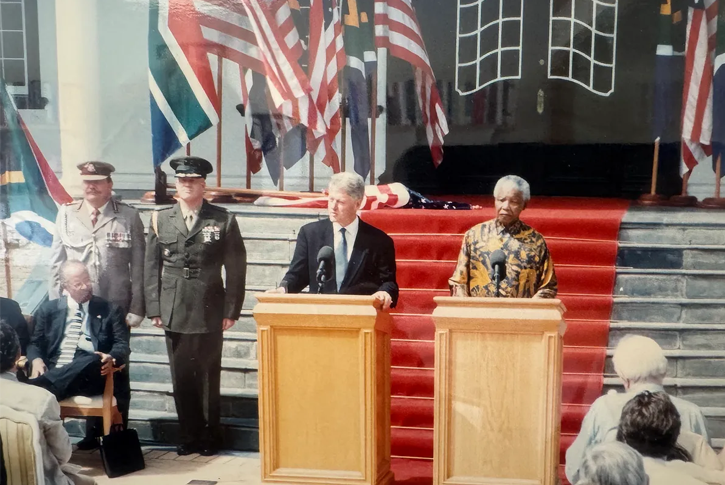
A photo from the March 1998 Clinton-Mandela press conference.
America’s new Ambassador to South Africa, Leo Brent Bozell III, arrived in South Africa this week, prompting me to reflect about the fraught relationship between our two countries and where we should go from here. I don’t think things are broken beyond repair, but Bozell, along with President Trump, will determine whether we move further apart, or recalibrate towards pragmatic cooperation.
I’ve been thinking about our relations with South Africa since I first traveled there in 1991, the year after Nelson Mandela was released from prison.
At that time, Mandela’s ANC was still advocating for sanctions against the White government. Foreign governments and firms debated the merits of ethical and economic arguments for engagement.
Of course, everything changed once Mandela became president. Americans and most of the world immediately and warmly embraced the country for its peaceful transition away from apartheid. South Africans became bullish on their future, anticipating an influx of trade and investment.
In March 1998, I got a back row seat, literally the last row, to a press conference featuring Bill Clinton and Nelson Mandela. They delivered their speeches with mutual admiration outside the South African president’s office in Cape Town. I was a Fulbright Fellow at the time and had been asked to accompany the White House press corps on the day of the speeches.
While the speeches celebrated a deepening friendship and there was an unmistakable buzz in the air, there were also clearly some unresolved tensions, largely born of the fact that the ANC and the U.S. government had been on different sides of the Cold War, and the U.S. had been noticeably late to support the anti-apartheid movement.
Mandela highlighted that he had already welcomed Cuban president Fidel Castro and Libya’s Muhammar Qaddafi to the country, laying bare a tangible misalignment. Nonetheless, he made clear that South Africa’s friendship with foes of the United States would not stand in the way of a dignified and productive relationship between the two countries, a point that Clinton tacitly accepted.
Bilateral relations have remained strong, but early American apprehensions about the friends the ANC was keeping have continued to surface. Biden’s ambassador to South Africa, Reuben Brigety, caused a row when he accused South Africa of providing weapons to Russia in its war with Ukraine. And in March 2024, two members of Congress advanced a bilateral bill chastising South Africa for its opposition to Israel and for its engagement with several American foes. The bill failed to pass, in line with the longstanding modus vivendi that has persisted to mutual benefit, but it was a harbinger of what was to come.
The US-South Africa relationship has soured notably under Trump.


