
News
Q&A: From seed funding to scientific breakthroughs
How the MIT Global Seed Funds helped Professor Matt Shoulders and his team build international collaborations that continue to shape his research more than a decade later.
How the MIT Global Seed Funds helped Professor Matt Shoulders and his team build international collaborations that continue to shape his research more than a decade later.
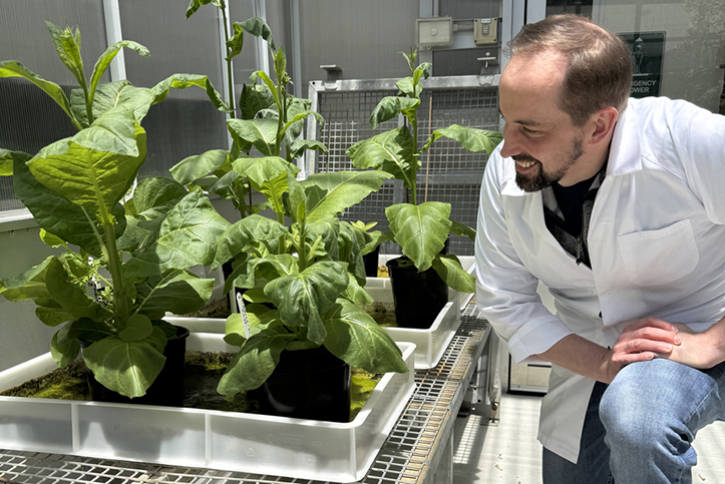
“Fourteen years later, that first GSF grant is still shaping the work we do," says Matt Shoulders, Class of 1942 Professor of Chemistry and department head
The MIT Global Seed Funds (GSF) are designed to do more than launch research projects — they build international collaborations that make ambitious science possible. By supporting early-stage collaborations with researchers around the world, the program helps faculty test new ideas, exchange expertise, and lay the groundwork for discoveries that often grow far beyond the initial award.
Matt Shoulders, professor of chemistry and department head, has experienced that impact firsthand. Since his first GSF grant in 2013, the collaborations these grants enabled have led to major research programs in protein engineering, photosynthesis, collagen biology, and gene-editing technologies, as well as subsequent funding.
The GSF helps Institute faculty and principle investigators create exciting new connections with colleagues abroad. GSF supports early-stage, open and publishable research collaborations with researchers at academic universities and public research institutions around the world. Administered by the Center for International Studies, GSF has awarded more than $30 million to over 1,300 faculty research projects since its inception in 2008. The current call for proposals from MIT faculty and researchers with principal investigator status is open until Dec. 3.
Q: What makes Global Seed Funds unique?
A: This has to be one of the standout ways to develop international collaborations that any school has anywhere. It's an extraordinary way to build serious relationships with people who have science that you can work on together, get to synergistic and exciting outcomes, and start projects that you could never get going otherwise.
I've found it to be an enormously valuable bridge-building mechanism for creating opportunities to work with other groups.
I started as an assistant professor in 2012 and received my first Global Seed Funds grant in 2013, probably within eight months of starting. That opportunity let me get to know an expert whose field of research was exactly what we needed. We published only one paper together, but that collaboration led directly to my first major NIH [National Institutes of Health] funding — a Director's New Innovator Award that brought nearly more than $2 million to the lab. It became the basis of what's still one of our lab's major research projects.
We never would have built that relationship otherwise. We visited their lab, they visited ours, our students exchanged visits, and together we built a whole platform for protein engineering that we still use all the time. Fourteen years later, that first GSF grant is still shaping the work we do.
That story has repeated itself over and over again. The collaborations have led us in lots of directions and created opportunities for different science along the way. Looking back, I think the GSF funding we've received can be directly connected to roughly $18 to $20 million in outside research funding. Of course, it wasn't only the GSF grants, but without them much of that later funding probably wouldn't have happened.


