
Commentary
No equilibrium in sight
Notes from the New World Order Symposium at MIT’s Center for International Studies by Evan Lieberman, CIS director.
Notes from the New World Order Symposium at MIT’s Center for International Studies by Evan Lieberman, CIS director.
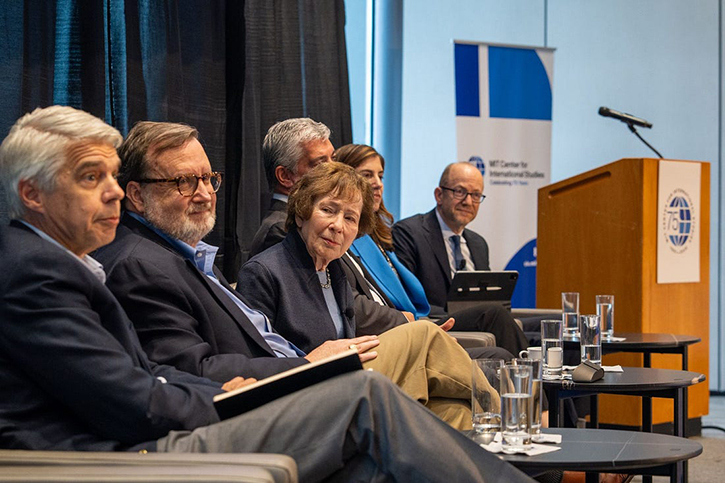
Left to right: Eric Evans, Richard Mills, Suzanne Berger, Marcos Troyjo, Dafna Rand, Evan Lieberman. Photo credit: Anna Walsh
In my role as director of MIT’s Center for International Studies (CIS), last week I presided over a two-day symposium built around one question: “The Next Quarter Century: What Kind of New World Order?”
And the verdict? My take on the shared wisdom is that we are in a period of disequilibrium with respect to how power is being exercised around the world, and no stable order is in sight. That uncertainty is making a range of serious dangers worse, among them, the risk of nuclear conflict, halted progress on climate change, ungoverned technologies, and harm to the health systems of the poorest countries.
The occasion for the October 15–16 symposium was CIS’s 75th anniversary. We were founded in 1951, when the Cold War was running hot in Korea, and the US government was eager to bring university experts into a joint project of research and policy. Like other centers for international studies and area studies created around this time, CIS was intended to advance research and teaching about foreign countries and cultures (in service, it must be said, of American interests and influence).
Today, the world looks very different. China’s rise has upset American dominance. Russia has reemerged as a disruptive force, and the Trump administration has wavered in its posture toward that country. And where Washington once poured money into university expertise on the wider world, government investment in higher education is now moving in the opposite direction. Given these changes, we used our anniversary to ask experts doing serious research and policy work what the world looks like from their perspectives, to put them in conversation with one another, and to reflect on our own mission as we look to the future.
We opened Thursday afternoon with a keynote by Anne-Marie Slaughter, former director of Policy Planning at the US State Department and incoming dean of the LSE School of Public Policy. Her provocatively titled talk, “What Would the US Do in a Middle-Power Order?” built on Canadian Prime Minister Mark Carney’s vision of a world in which countries form alliances and cooperate with one another to insulate themselves from the great powers.
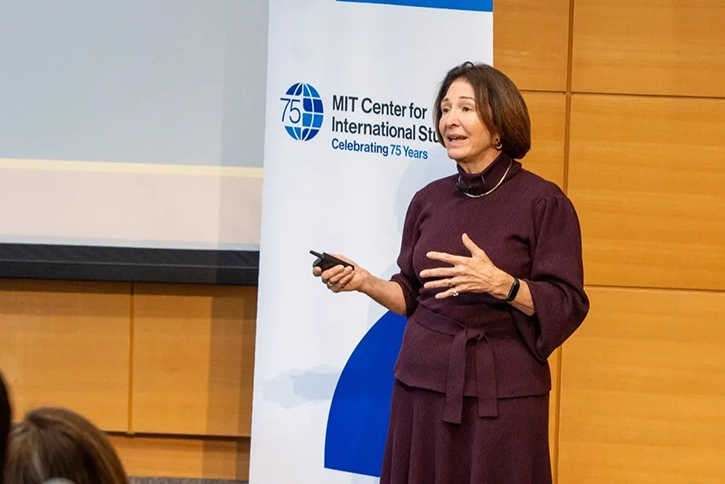
Anne-Marie Slaughter at the October 15 Starr Forum / Keynote (Credit: Anna Walsh)
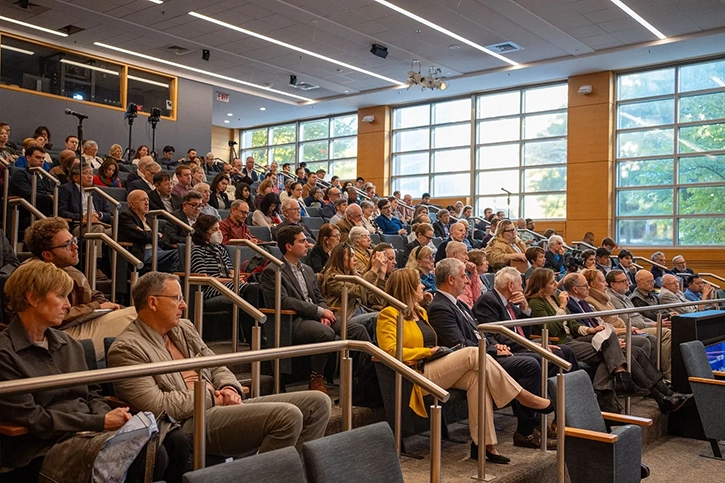
Credit: Anna Walsh
Slaughter described a possible middle-power order as an “armadillo order,” characterized by overlapping scales of armor. One layer is made up of “minilaterals,” narrower agreements among smaller groups of countries with shared interests. Others are formed by transnational and subnational actors such as cities, corporations, and individuals. These arrangements, including the Mecca Defense Pact and the Baltic Coalition, are less ambitious than the great-power alliances of the past. But Slaughter argued that enough of them together could redefine the world order and reduce other nations’ dependence on the United States and China. She didn’t play down the challenges ahead, but did offer this vision as an optimistic alternative to the status quo.
As a good keynote should, her remarks set the terms for much of what followed. Some speakers and audience members embraced her view. Many others doubted that we would soon see a world in which middle powers have much more ... power.
On Friday we held four panels and roundtables of scholars and policymakers, most of them from CIS, on the forces reshaping our world. (Video recordings will be posted to our YouTube channel.) We began with the main sources of disruption and insecurity. Next came the challenges of transnational governance in areas like trade and development assistance, followed by perspectives from six world regions. We closed with a roundtable on what CIS and MIT can do at a moment of apparent disorder.
I’ll return to discussions of the topics covered in the first three panels in future posts. Many of the speakers engaged the middle powers framework, and echoed the idea that we have entered an increasingly transactional moment, one in which a shared moral framework seems to be lacking.
During the final roundtable, MIT Institute Professor Suzanne Berger argued that the “new world order” is defined by nationalism, and that the possibility of war will be “ever-present.” She cautioned against too much faith in the likely strength of emerging middle power alliances, noting that the EU was built on common values, a shared culture, and a rejection of domination. And yet, according to Berger, the EU has been extraordinarily weak, particularly in dealing with Russia and the United States.
Dafna Rand, former assistant secretary of State for Democracy, Human Rights, and Labor and a 2025–26 Wilhelm Fellow, struck a similar note. She called the current moment an “Un-lateral (dis)order,” or an “ROI order.” In her account, nationalism, chaos, and unpredictability prevail, and few actors show any interest in providing public goods. Citizens and leaders alike demand a return on investment from foreign policy, as if every country had its own “America First” instinct.
Our other Wilhelm Fellows on the roundtable, Marcos Troyjo, former deputy minister of the Economy in Brazil and former president of the New Development Bank, and Richard Mills, former US ambassador to Nigeria, also raised questions about the viability of the middle powers framework, while accepting parts of Slaughter’s political analysis. Mills described the domestic side of the inward turn. When he spoke at a college campus in 2016 about the United States as a transformative global power, students pushed back hard, rejecting that longstanding ambition, arguing for an agenda that sounded more like America First.
No one doubted that the great powers will maintain their military and economic weight. But the inward turn in so many countries’ foreign policies, along with frustration with the record of great power leadership, has left citizens and governments scrambling for alternatives.
I asked for suggestions regarding what all of this might imply for a Center founded to meet a very different moment. Many of our roundtable speakers had terrific ideas — largely premised on a faith in the value of globalism (which I share) — including: continue to promote international education through travel and exchange, which argues for leaning into MISTI, our international experiential education program; foster international collaborations; use research to communicate the most cost-effective investments in international activities; and more generally, stay open to the world.
This geopolitical disequilibrium demands more reflection and analysis. We may not have the ear of government nearly to the degree of generations past. On the other hand, the diffusion of power demands that we engage with a much wider group of actors and to consider the strategies that might mitigate dangers and increase the likelihood of broadly shared prosperity. This is a time for serious research and engagement, and the stakes seem as high as any in our 75-year history.
Over the coming months, I’ll return to many of the symposium’s other insights here.


