
News
Hackathon tackles real-world challenges in Ukraine
Build for Ukraine 2.0 united students, researchers, and Ukrainian collaborators to prototype solutions shaped by wartime conditions.
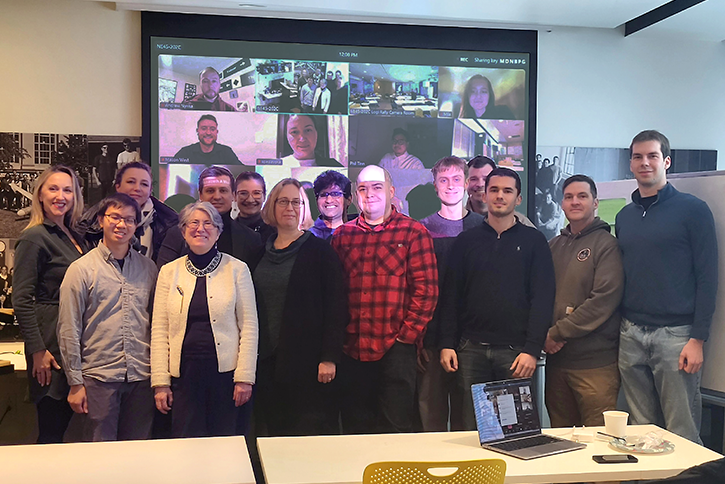
The Build for Ukraine students and collaborators.
During this year’s Independent Activities Period, students, researchers, and partners across seven time zones came together to tackle urgent technical challenges facing Ukraine as the full-scale war enters its fifth year.
The four-week hackathon, Build for Ukraine 2.0, brought MIT students and Ukrainian collaborators into a shared innovation environment where power outages, air-raid alerts, and subzero temperatures were part of the daily reality of teamwork.
The event was co-led by the MIT-Ukraine Program, MIT Edgerton Center, and MIT Lincoln Laboratory Beaver Works, with support from Mission Innovation X, MathWorks, and MIT.nano.
Designed and taught as an IAP subject (EC.S01/EC.S11), the hackathon paired technically diverse participants with Ukrainian organizations seeking near-term solutions to problems arising directly from wartime conditions.
“It’s not every working group that has to reschedule team meetings because some members are in Ukraine and just had a blackout,” Hosea Siu ’14, SM ’15, PhD ’18, one of the lead organizers. “This class is unusual — in the most meaningful ways.”
A collaborative class built for real-world urgency
Build for Ukraine centered on co-design and rapid prototyping with in-country partners. Organizers spent the fall gathering challenge statements from stakeholders in Ukraine, Taiwan, the United Kingdom, Spain, and across the United States. The goal: identify problems where a small, interdisciplinary team could make measurable progress in one month.
The participant pool reflected MIT’s open IAP structure. First-year undergraduates worked alongside senior engineers, international researchers, and Ukrainian colleagues participating remotely despite frequent blackouts. Many joined meetings from darkened apartments in Kyiv, Kharkiv, and Cherkasy — often relying on unstable heaters and backup battery packs. One participant excused himself from a design review due to an air-raid alert.
“These groups developed what I call ‘quantum entanglement,’” said Svetlana Boriskina, a principal research scientist at MIT and director of the Multifunctional Metamaterials Laboratory in the Department of Mechanical Engineering. “They were sharing data in real time across continents, while experiencing the war’s impacts directly and indirectly.”
Setting the foundation: briefings and technical overviews
The first week introduced participants to the geopolitical, technical, and humanitarian landscape that would frame their work. Topics included:
Five teams, seven time zones, and one month of development
Nearly ninety people joined the project through Discord, and by the end of week one, five core teams had formed. Roles blurred: undergraduates mentored professionals; Ukrainian engineers supplied real-time operational data; and faculty offered rapid problem-solving guidance. Each team completed a Preliminary Design Review, Critical Design Review, and final presentation to an audience of more than 80 people online and in person.
Despite the compressed timeline, the teams delivered promising prototypes and analyses with potential real-world application.
Team highlights
Clearview Interface — Visualizing metal-detector data for safer de-mining
Two undergraduates from Olin College developed a method for converting complex metal-detector audio signals — often an overwhelming sequence of indistinguishable beeps — into intuitive visual information. Their approach could help de-miners identify object types more quickly and accurately, enhancing both safety and mapping. The team reverse-engineered commercial detector outputs and produced a preliminary interface they plan to refine this spring.
HotPot — Acoustic monitoring for nuclear-reactor cooling systems
This team of seven (five at MIT and two from the Kharkiv Institute of Physics and Technology) worked to detect transitions from water to supercritical states inside steam pipes — a critical safety parameter in nuclear facilities that have remained in operation during wartime. Combining physics simulations, hardware engineering, and acoustics, the group analyzed data from Ukrainian partners and proposed a model capable of identifying supercritical conditions via remote monitoring.
Birdwatch — Acoustic detection of fiber-optic-controlled drones
With drones frequently used along the front and often tethered to fiber-optic control lines that evade RF detection, the Birdwatch team built an audio-based detection system using a network of cameras and microphones. They trained their model on drone signatures recorded across MIT’s campus and integrated early detections into a decision-support tool to help operators interpret and act on the alerts.
Hrobachki — Radiofrequency localization for long-range drones
Two MIT students, along with collaborators at Kenyon College, Olin College, and a partner in Cherkasy, Ukraine, focused on RF detection for drones operating beyond front-line distances. They established nodes at MIT, Olin, and the town of Milton, Massachusetts, demonstrating the feasibility of distributed RF sensing for aerial threat identification.
VibeTracking — Following the movement of disinformation narratives
The smallest team — a master’s student in Lviv supported by several advisors — partnered with IN2 to build a large-language-model pipeline that classifies and groups narratives across platforms such as Telegram and X. Their system demonstrated the likely propagation path of a specific narrative, illustrating how early-stage disinformation can be identified before it reaches mainstream channels.
Resilience, connection, and next steps
On the final day of presentations, specialists from Ukrainian universities, industry partners, and MIT-affiliated programs filled the room and populated the Zoom call. Their response was enthusiastic, not only because of what the teams produced in four weeks, but because of the collaborative networks formed under difficult conditions.
“The most important outcome is the community that emerged,” Boriskina said. “These teams built tools — but they also built relationships that will carry this work forward.”
Organizers expect several projects to continue this spring through research internships, UROPs, and follow-on collaborations with Ukrainian institutions.
Get involved
Students interested in joining ongoing Build for Ukraine projects can email mit-ukraine@mit.edu.
To support initiatives of the MIT-Ukraine Program, contact Svitlana Krasynska at svitkras@mit.edu.


