Five forces that will shape the global landscape over the next twenty-five years
CIS marked its 75th anniversary with a symposium examining the forces reshaping the international order. What will the world look like over the next quarter century?
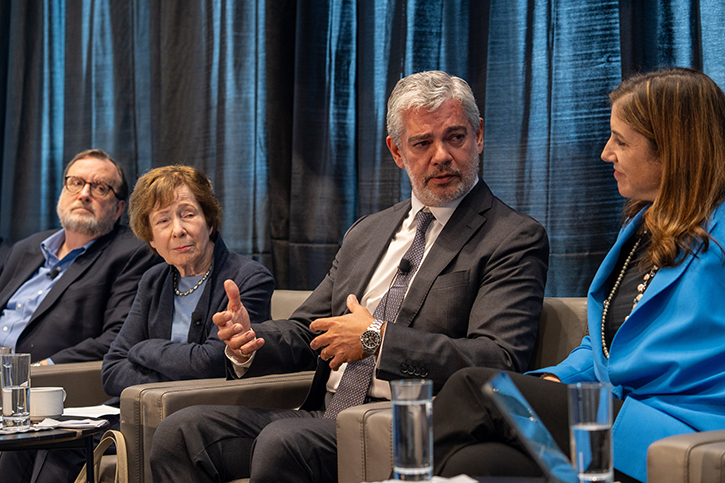
Marcos Troyjo speaking at the Center for International Studies' 75th symposium, The Next Quarter Century: What Kind of New World Order? From left to right: Richard Mills, Suzanne Berger, Troyjo, Dafna Rand
The MIT Center for International Studies marked its 75th anniversary with a symposium examining the forces reshaping the international order. As the Center looks toward its centennial in 2051, the occasion offers an opportunity to consider a fundamental question: What will the world look like over the next quarter century?
Predicting the future is always hazardous, particularly at a time when geopolitical competition, technological disruption, demographic transformation, and economic interdependence are interacting in increasingly complex ways. Yet identifying the structural forces likely to influence the international landscape is both possible and necessary.
The globalization of recent decades was characterized by the expansion of international trade, the extension of production networks across borders, the rise of digital technologies, and the integration of emerging economies into global markets. Economic efficiency frequently prevailed over strategic considerations. Supply chains were designed primarily to minimize costs, while technological innovation appeared increasingly capable of transcending geography and natural-resource constraints.
The next 25 years will be different. National security will increasingly influence economic decisions. Technological sophistication will coexist with growing dependence on physical resources. Demographic expansion will reshape consumption, infrastructure, and investment. Emerging economies will account for an increasingly significant share of global economic dynamism. It will be a quarter century powered by “ESG 2.0”: Economy, Security and Geopolitics.
Five structural forces stand out as particularly consequential.
The original China Shock was fundamentally about what China sold to the world. Following China's accession to the World Trade Organization in 2001, its extraordinary expansion as a manufacturing powerhouse transformed international trade, production networks, and labor markets. Consumers benefited from lower prices, while industries across developed and emerging economies confronted unprecedented competitive pressures.
The consequences were profound. China's integration into global markets contributed to one of history's most remarkable episodes of economic growth and poverty reduction. At the same time, it accelerated deindustrialization in numerous regions and fundamentally altered the geography of manufacturing.
The next quarter century may witness a different phenomenon, which I call China Choke. While China Shock was defined by what China sold, China Choke will be defined by what China can withhold, what it chooses to buy, and from whom.
China's position in strategic supply chains, particularly in critical minerals processing, batteries, advanced manufacturing inputs, and other industrial ecosystems, provides Beijing with substantial leverage over the global economy.
The capacity to restrict access to indispensable inputs may become as consequential as the ability to export competitively priced manufactured goods.
But China Choke also has a demand dimension.
As China's economy matures, its demographic profile changes, and its industrial and technological priorities evolve, decisions concerning what it imports—and from which countries—will increasingly influence the fortunes of commodity exporters, agricultural producers, and energy suppliers.
Countries that have benefited from China's appetite for raw materials may confront a more selective and strategically oriented Chinese market.
The result will be a reorganization of globalization around questions of economic security, strategic dependence, and geopolitical alignment. In this environment, interdependence will remain a defining feature of the world economy, but it will increasingly be managed as an instrument of national power.
Over the next 25 years, the United States is likely to remain an extraordinary economic, technological, financial, military, and entrepreneurial powerhouse.
Its universities, research institutions, venture-capital ecosystem, financial markets, and capacity for technological innovation will continue to provide formidable advantages.
The United States will retain substantial influence over the technologies that shape tomorrow's economy, from artificial intelligence and biotechnology to aerospace, advanced computing, and defense systems.
Its military capabilities and the international role of the dollar will remain important foundations of American power.
The fundamental question, therefore, is not about whether the US will possess the capabilities required for global leadership. It is about how the US will choose to exercise them.
Will Washington continue to invest in alliances, shape international institutions, foster trade relationships, and strengthen the architecture of global economic cooperation? Or will it increasingly adopt an inward-oriented approach, putting international engagement aside? The answer will have consequences far beyond US borders.
For decades, the United States has played a central role in providing security guarantees, supporting international financial stability, fostering technological innovation, and shaping the rules governing global commerce.
A more inward-looking America would not necessarily become a weaker America. But it would create a different international environment, compelling allies, competitors, and emerging powers to reassess their strategic choices.
Conversely, renewed American international engagement could reshape partnerships, reinforce institutions, and influence the direction of technological and economic competition.
The next quarter century will therefore be designed not only by America's capabilities, but by its willingness to translate those capabilities into international leadership.
The next 25 years will also be characterized by an extraordinary demographic transformation.
We are moving from a planet of approximately eight billion people toward one approaching ten billion in 2051. Two billion people extra is equivalent to the combined populations of China, the US and Indonesia.
Even if population growth gradually decelerates, the economic implications of this transformation will be enormous. More people will require more food, energy, water, housing, healthcare, transportation, and infrastructure. The scale of investment necessary to accommodate these demands will be unprecedented in many parts of the developing world.
Agricultural productivity will need to increase. Energy systems will have to expand and diversify. Cities will require new infrastructure. Healthcare systems will face growing demands arising from both population expansion and aging.
Yet global demographic trends will be far from uniform. Some societies will experience population decline and rapid aging, while others, particularly in Africa and parts of Asia, will continue to expand.
These contrasting trajectories will reshape labor markets, migration patterns, consumption, and the international distribution of economic opportunities. For resource-rich economies, demographic expansion may create substantial new markets for agricultural products, energy, minerals, and infrastructure-related inputs.
For technologically advanced societies, the challenge will increasingly involve maintaining productivity amid aging workforces. For developing countries with younger populations, the opportunity will lie in transforming demographic expansion into human capital, employment, and sustained productivity growth.
The central challenge will be to produce more, distribute better, and use resources more efficiently.
Demography, in other words, will not merely influence the size of future markets. It will help determine the geography of economic development, the distribution of geopolitical influence, and the sustainability of global prosperity.
One of the most consequential transformations of the coming quarter century will be the changing relative contribution of developed and emerging economies to global growth.
Since the second half of the 1970s, the Group of Seven has symbolized the central role of the world's leading advanced industrial economies in international economic governance.
Yet the geography of economic dynamism has been changing. The seven major emerging economies (China, India, Brazil, Indonesia, Turkey, Mexico and Saudi Arabia) that I refer to as the E7 are positioned collectively to contribute more to the expansion of global output than the traditional G7.
This is not simply a question of which group has the larger aggregate GDP at a particular moment.
The more consequential issue is which economies generate the largest incremental contribution to global economic activity. In 2026, China and India alone are expected to drive around 43% of global gdp growth.
Over the next 25 years, emerging markets will increasingly influence where new consumers are located, where infrastructure is built, where factories are established, and where investment opportunities arise. The implications extend well beyond international trade. The sources and destinations of foreign direct investment will evolve as multinational corporations reassess production locations, market access, and geopolitical risks.
Consumption patterns will change as middle classes expand across emerging economies, generating demand for goods and services ranging from food and housing to transportation, healthcare, education, and digital technologies.
Financial capital allocation will increasingly reflect these transformations.
Global investors will need to reconsider traditional assumptions about the relationship between economic maturity, market size, growth potential, and geopolitical influence.
The resulting transformation will also raise questions about international economic governance. Institutions designed around the distribution of economic power in the twentieth century will face growing pressure to accommodate the realities of the twenty-first.
The emergence of new centers of growth does not imply the disappearance of advanced economies' technological, financial, or institutional advantages. It does, however, suggest a more geographically dispersed international economic system, in which emerging economies will play a progressively larger role in determining the direction of globalization.
The fifth structural force is what I call the Highlander World — a reference to the 1986 film Highlander that alternates between scenes depicting contemporary, technology-intensive settings and others showing essential natural elements.
Its defining characteristic is a paradox: technology will increasingly have the upper hand, but technological progress will depend more heavily on access to strategic natural resources.
The software revolution of the 1980s was often associated with an economy becoming less dependent on physical inputs. Value creation increasingly appeared to originate in intangible assets, intellectual property, and computational capabilities.
The emerging technological paradigm is different.
Artificial intelligence, robotics, drones, advanced defense systems, and next-generation industrial technologies require vast quantities of energy, sophisticated physical infrastructure, and reliable access to critical minerals. The technological frontier is becoming more resource-intensive, not less.
Nvidia CEO Jensen Huang's description of artificial intelligence as a five-layer ecosystem provides a particularly useful illustration. At its foundation are energy and the physical resources necessary to sustain computational activity, including land, water, and critical minerals.
The second layer consists of chips and semiconductors, the computational engines powering artificial intelligence. The third encompasses infrastructure, particularly data centers and the systems required to operate them. The fourth consists of artificial intelligence models, including large language models and open-source or proprietary systems.
Finally, the fifth layer comprises applications, where technological capabilities are translated into products, services, and economic value.
The significance of this framework extends beyond artificial intelligence.It demonstrates that the most sophisticated technological activities ultimately depend on an extensive foundation of physical resources and industrial capabilities.
Without reliable electricity, there can be no large-scale AI infrastructure. Without critical minerals, semiconductor production and advanced manufacturing face significant constraints. Without land, water, and infrastructure, the expansion of computational capacity becomes increasingly difficult.
This interdependence has profound geopolitical implications. Countries endowed with strategic natural resources may acquire new forms of economic relevance, provided they develop the infrastructure, institutions, human capital, and investment conditions necessary to participate in advanced value chains.
For emerging economies, the Highlander World represents an opportunity to move beyond the traditional role of supplying commodities. They can seek to participate in processing, manufacturing, technological infrastructure, and other higher-value activities associated with the emerging global economy.
The future will not necessarily belong exclusively to countries possessing the most advanced technologies, nor to those controlling the largest reserves of natural resources. It may increasingly favor those capable of combining both.
Taken together, these five forces suggest that the international landscape of the next quarter century will differ substantially from the one that characterized the opening decades of the twenty-first century.
China's economic influence will increasingly reflect its control over strategic inputs and its decisions concerning global demand. The US role will depend not only on its extraordinary capabilities but also on its choices regarding international engagement.
Demographic transformation will create enormous pressures on resources and infrastructure while opening new avenues for investment and development. Emerging economies will contribute an increasingly significant share of global economic expansion, reshaping trade, consumption, investment, and financial capital allocation.And technological progress will become ever more intertwined with access to energy, land, water, and critical minerals.
These transformations will generate risks, but also extraordinary opportunities. For policymakers, the challenge will be to reconcile economic competitiveness with national security, technological ambition with resource availability, and domestic priorities with international cooperation.
For businesses and investors, success will require understanding how geopolitical realignments, demographic shifts, and technological innovation interact to redefine markets and value chains.
For emerging economies, the central opportunity will be to convert demographic potential, natural-resource endowments, and expanding markets into sustained productivity growth and greater technological sophistication.
As MIT's Center for International Studies looks from its 75th anniversary toward its centennial in 2051, these are among the forces that will help define the world it seeks to understand.
The next 25 years will not simply be a contest between established and rising powers, or between technology and natural resources.
They will be characterized by the growing interaction of economic dynamism, geopolitical strategy, demographic change, and technological transformation.
The future will not simply belong to those who possess the most resources or develop the most advanced technologies. It will belong to those who best combine the two.
That may be the defining opportunity—and one of the greatest challenges—of the next quarter century.
Adapted from remarks delivered at the MIT Center for International Studies 75th-anniversary symposium, October 16, 2026.
Marcos Troyjo is a MIT Robert E Wilhelm Fellow at the Center for International Studies. He is a former president of the New Development Bank and Brazil’s former special secretary for foreign trade and international affairs.