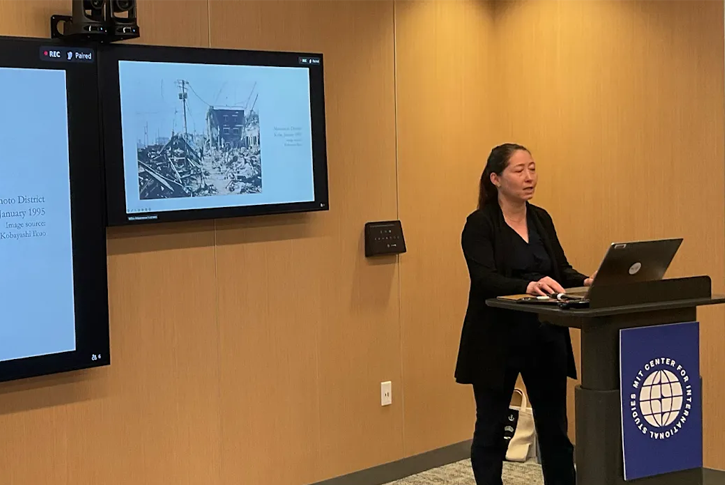
In an increasingly dangerous world, Japan offers some stunning examples of how design-based strategies can help us to prepare for the worst. My MIT colleague from the School of Architecture and Planning, Miho Mazereeuw, who directs the Urban Risk Lab, delivered a fascinating account on disaster preparedness in that country at the Global Research & Policy seminar at CIS this week (based on her recently published book Design Before Disaster: Japan’s Culture of Preparedness). Commemorating 15 years since the tragic March 11th, 2011 earthquake and ensuing tsunami and nuclear disaster, she detailed a number of clever and extremely elegant design innovations that help people to be ready in case they are displaced, and/ or lack ready access to basic supplies, electricity, sanitation, etc. (As a designer, she also presented stunning graphics explaining these ideas—reminding me how hideous my average PowerPoint or Beamer slide looks by comparison.)
Mazereeuw described the development of cleverly cantilevered seawalls that allow residents to continue to work and recreate in the oceans that are often central to their culture, while also protecting them from rising sea levels and the increasing threat of tsunamis. She showed how parks and playgrounds serve the dual use of recreation areas and as safe havens in case of emergencies – with park benches doubling as barbecues, and manholes doubling as toilets.
She described neighborhoods that stored food in case of emergency. When they get through the year without any emergencies, they celebrate by eating the food and throwing a party as a way to renew their commitment to one another, and to replenish supplies. The celebrations are held at schools that double as emergency shelters, and the events provide opportunities for refreshers on protocols where the environment is one of joy, not anxiety. Playground balcony viewing areas used to cheer on classmates during normal times are constructed as rapid escape routes for emergencies.
Could such innovations offer lessons for how the rest of us adapt to the polycrisis of climate change, pandemic threat, and a range of other global disruptions in ways big and small? In theory, we should be able to borrow from these examples of Japanese ingenuity in the face of danger.
And yet, Japan is a place where people are willing to carry their own trash around for much of the day, for disposal at home, rather than littering or filling public bins. In Japan, people don’t jaywalk, they keep their voices hushed in crowded environments, and they operate in a remarkably orderly manner. It’s not just their disaster preparedness culture that is unique, but their culture more generally, and I’m not sure how easily some of their most social innovations could travel. Mazereeuw said in response to a question I asked concerning the origins of Japan’s uniquely high preparedness – which she emphasized was itself not uniform across the country – was due to the fact that the country has faced so many different natural and other disasters. Perhaps, but I suspect it is more than that. Plenty of disaster-prone places fail to learn from the past and remain vulnerable time and again. Moreover, Mazereeuw emphasized that emergency planning is harder in cosmopolitan Tokyo, filled with people who have been living there only a few years, where shared history and trust are lacking relative to other parts of the country.
The lesson is clear: good design is not enough. Preparedness ultimately depends on social and political conditions.