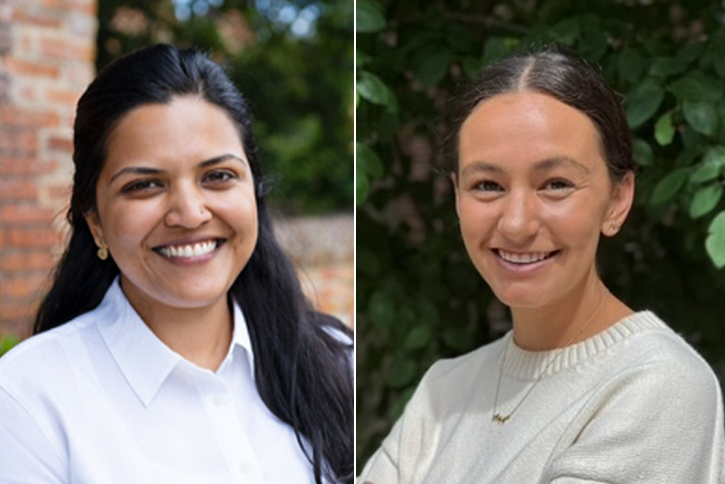
Mrinalini Penumaka and Julia Lodoen are the recipients of the 2025 Jeanne Guillemin Prize awarded by the MIT Center for International Studies. The prize provides essential funding for female graduate students conducting research in international affairs.
Penumaka is a PhD student in the Department of Urban Studies and Planning, while Lodoen is pursuing a PhD in political science within the MIT Security Studies Program.
Sifting through the shadows of Argentine democratic history
The prize sent Lodoen to Buenos Aires, Argentina, this past summer, where she spent eight hours a day, “flipping through giant piles of documents in multiple archive collections: Archivo Nacional de la Memoria, Archivo Provincial de la Memoria, and Comisión Provincial de la Memoria.
The questions Lodoen set out to answer during this stage of her research related to how the democratic and authoritarian state of Argentina in the turbulent 1970s and 80s targeted and “disappeared,” murdered, or unjustly imprisoned citizens. “I wanted to understand what their repressive apparatuses looked like, how they communicated, the propaganda they used, the violent acts they committed, and how they justified them,” she said.
She could only examine the majority of these sources in person, as many of the cases of civilian killings or disappearances remain open even decades later. That means that by law, many documents cannot be accessed online or photographed. Lodoen said that the majority of the sources that she wants to draw from in her dissertation have to be approved by the archivists, who first remove names from the documents she requests, which include military reports and police workbooks as well as top secret meeting reports from intelligence agencies, which convened to discuss who to target, labelling each individual with a corresponding threat level.
“By creating these informal institutions that target people, you can see how they’re undermining the democratic process in the shadows,” Lodoen explained.
Argentina and Uruguay are both case studies for Lodoen’s dissertation, which takes a historic perspective, as does all of her research. “I study how democracies have used different types of state security bureaucracies to suppress their citizens,” she said. “I look at formal bureaucracies, like military and police institutions, and informal bureaucracies which are state-created or state-adjacent institutions more clandestinely tied to the state.”
The climate crisis examined through water and energy service provision in South Africa
Thanks to the prize funding, Penumaka spent several weeks in South Africa, conducting preliminary interviews with stakeholders from utility companies and local grassroots organizations who are navigating the challenges of translating international climate policies for energy and water service delivery. As a result, she was able to map out her plan for an extended, even more ambitious fieldwork trip planned for winter 2026.
Penumaka’s dissertation looks at how international climate policy and financing tackle the climate crisis, zeroing in on modern-day South Africa, a heavily coal-reliant nation still reeling from Apartheid, a system that relegated poorer, non-white citizens to informal communities or townships, where there is still tremendous inequality when it comes to accessing reliable electricity or water even today. Even as the country strives to implement energy transitions, it does so with what Penumaka views as “encoded forms of racialized urban planning.”
She said that in her research, she thinks about people’s everyday experiences of grappling with resource scarcity and the unaffordability of living in cities. “One concrete way in which you experience the electricity and water crises in low-income neighborhoods is by the absence or instability of provisioning. Or in terms of the unequal burden of the cost of electricity or water tariffs on poor households.”
As a PhD candidate, MIT gave Penumaka the opportunity to attend COP28 in 2023 in the United Arab Emirates, where she observed climate negotiations firsthand at the world’s leading summit on the topic. She noticed government officials and climate negotiators from the Global North and South making different arguments about how their respective countries could adopt climate transition plans based on their history, economic development goals, and natural resource needs.
“South Africa was having debates about how, both at a national and state level, this mandate of a just transition, particularly when it came to water and energy, could translate into policy and implementation,” she said. The conference sparked her dissertation topic and desire to spend time on the ground running focus groups with civil society actors, neighborhood residents, and local leaders.
“The climate crisis is not just about reducing greenhouse gas emissions and decarbonizing our infrastructure. It’s about thinking through fundamental questions on development,” she said with conviction.
Research that matters
Both Lodoen and Penumaka were drawn to MIT for their graduate studies after working in the field as practitioners.
For Lodoen, there was a plot twist first. Growing up, her mother, who is from Argentina, would weave incredible stories about the country’s history that captured her interest. When Lodoen was in her teens, The Hunger Games and its wider genre of Dystopian novels and films became popular. She was passionate about them and branched out to read interconnected history books that explored the rise and fall of totalitarian regimes.
Although she arrived at the University of Chicago intending to become a physician, a class taught by MIT Political Science alumnus Paul Staniland PhD ‘10 on insurgency, terrorism, and civil war changed Lodoen’s path entirely. It reignited her passion for regime history. She went on to change her major to political science, take every one of Staniland’s courses, and complete a one-year MA in International Relations at the school. “From then on, all roads led to MIT,” she admitted.
After graduation, she worked at the Washington, DC-based Stimson Center, focusing on nuclear strategy for India and Pakistan. There, she was mentored by multiple MIT Political Science alumni. At MIT, Lodoen has found a community of like-minded researchers and practitioners.
“I really like the type of research that is coming out of the Security Studies Program, which does a lot of historical case studies. I thrive in investigative projects–going to an archive and hunting clues down,” she said.
When Lodoen learned about the prize’s benefactor and namesake, Jeanne Guillemin, a former senior fellow in the Security Studies program, it was a lightbulb moment. “She was also an investigator,” Lodoen realized. “Winning this prize felt like a strong signal that people care about this type of work, that this is research that matters.”
Penumaka worked in the international development sector with a range of public sector and multilateral actors, including the World Bank and the Red Cross Climate Center, for over a decade before switching gears to pursue her PhD. One was Central Electronics Limited, an organization focused on renewable energy in rural India. That project sowed the seeds for further thinking about the energy transition in the Global South.
“I was part of two mini-solar projects trying to provide reliable electricity to unelectrified communities. On paper, according to the government, they had electricity. However, in practice, they had been living outside the reach of the formal energy grid for decades,” she explained.
She first worked in South Africa in 2011 as part of her undergraduate dissertation research at the University of Chicago. Later in 2019, as a researcher with the Red Cross Climate Center, she evaluated humanitarian responses to extreme drought and food crises in West Africa. She has felt drawn to conduct academic research on climate change grounded in the context and histories of the African continent ever since. She chose the International Development Group and Urban Studies & Planning department at MIT because of its dual commitments to practice and theory. At MIT, Penumaka has been mentored by Associate Professor of Urban Planning and International Development Gabriella Carolini, who directs the City Infrastructure Equity Lab, where she is part of a research team examining urbanization and climate adaptation in the Amazon.
“I’ve benefited from the mentorship of so many female faculty at MIT. Receiving this prize represents that there is space and support for female scholars here, particularly at the Center for International Studies,” Penumaka said. She imagines a future in which, as both an academic and a practitioner, she can make even more space for the next generation, too.
To learn more, please visit the CIS PhD Student Research Grants page or email questions to cis-info@mit.edu.